All case studies
FOOD & BEVERAGE
How a Multi Vendor Food Hall Platform Helped Centralize Billing, Vendor Operations, and Customer Flow Across a Shared Dining Space
Modern dining spaces with multiple vendors sharing seating and services. This system coordinates vendor operations, billing, and customer flow. Perfect for managing diverse food concepts.
React.jsNode.jsExpress.jsMongoDBSocket.IOTailwind CSS
View live product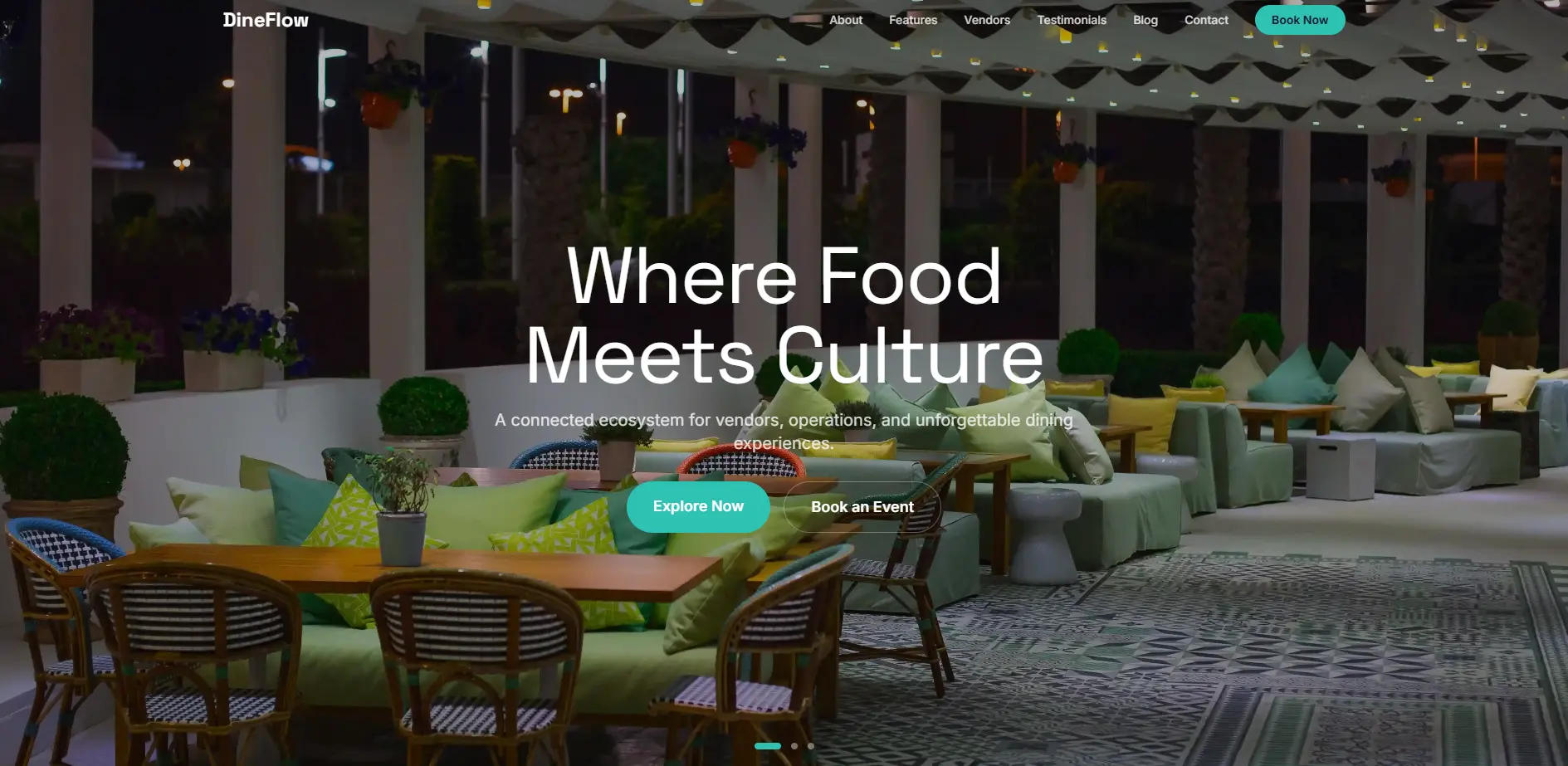
01 Challenge
Challenge
A modern food hall housing multiple independent vendors was struggling to operate as a unified dining experience. Each vendor ran its own ordering process, billing method, and internal workflow, which created constant friction at peak hours.
Customers ordering from multiple vendors faced inconsistent billing experiences, delayed order processing, and confusion at checkout. Staff had no shared system to track orders across vendors, and management had no real time visibility into overall performance or customer flow.
Because each vendor operated independently, there was no centralized way to coordinate orders, seating demand, or payment splitting. This led to longer queues, duplicated effort at the counter, and frequent reconciliation issues at the end of the day.
The business needed a system that could unify vendor operations without removing their independence, while also creating a seamless customer experience across all food concepts within the hall.
02 Approach & delivery
Approach & delivery
We designed and built a full Food Hall Management System using React.js and Node.js, with MongoDB managing vendor, order, and transaction data, and Socket.IO enabling real time synchronization across all vendor counters, kitchen stations, and the central management console.
The core design challenge was balancing two conflicting requirements: each vendor needed operational independence, but the customer experience needed to feel completely unified. To solve this, we created a layered architecture where vendors operate individually on top of a shared operational backbone.
At the frontend level, each vendor is provided with a dedicated POS interface tailored to their menu structure, pricing logic, and preparation flow. However, all vendor POS terminals are connected to a centralized order orchestration layer. This ensures that every order placed anywhere in the food hall is immediately visible across the system without requiring manual updates or cross communication between vendors.
We implemented a unified ordering engine that allows customers to place orders from multiple vendors in a single flow. Instead of forcing customers to queue separately at different counters, the system consolidates selections into a single transaction basket. Behind the scenes, the system intelligently splits orders by vendor, ensuring that each vendor receives only the items relevant to them while maintaining one seamless checkout experience for the customer.
To support this, we built a centralized billing and settlement system. This module automatically distributes payments across vendors based on order composition. It removes the need for manual bill splitting at the counter and eliminates reconciliation conflicts at the end of the day. Each vendor still receives independent financial reporting, but the customer only experiences a single unified payment process.
We also developed a real time vendor coordination layer powered by Socket.IO. As soon as an order is placed, it is instantly routed to the correct vendor station. Orders appear on vendor screens with clear categorization, timestamps, and preparation priority. This reduces communication delays and ensures that no order is missed during peak traffic periods.
A key component of the system is the shared seating and customer flow dashboard. This provides management with a live overview of table occupancy, order volume per vendor, and queue lengths across the entire food hall. Instead of reacting to problems after they occur, management can now actively balance customer flow by identifying bottlenecks in real time.
We also introduced a vendor performance analytics module that tracks sales, order volume, peak hour activity, and average preparation times per vendor. This data is aggregated at both vendor and food hall level, allowing operators to make informed decisions about staffing, layout adjustments, and vendor mix optimization.
On the operational side, we ensured that the system could handle high concurrency without performance degradation. Food halls experience sharp spikes in traffic, so we optimized the backend using event driven architecture and efficient state synchronization to ensure that order flow remains stable even during peak hours.
The rollout was executed in phases. We first onboarded a small group of vendors to validate the unified ordering and billing system, then gradually expanded to the full food hall. Staff training was conducted on site with vendor specific onboarding sessions to ensure smooth adoption without disrupting daily operations.
Ready to discuss your initiative?
We scope, build, and ship tell us what you're working on and we'll share relevant references.