All case studies
FOOD & BEVERAGE
How a QSR Chain Served 30% More Customers Per Hour After Deploying a High-Speed Multi-Lane POS System
Quick Service Restaurant Chain
A QSR chain with high footfall and high expectations was being bottlenecked by an aging POS that couldn't keep up. We built them a high-speed, multi-lane QSR POS system and throughput jumped by 30% in the first month.
React.jsNode.jsExpress.jsMongoDBSocket.IOTailwind CSS
View live product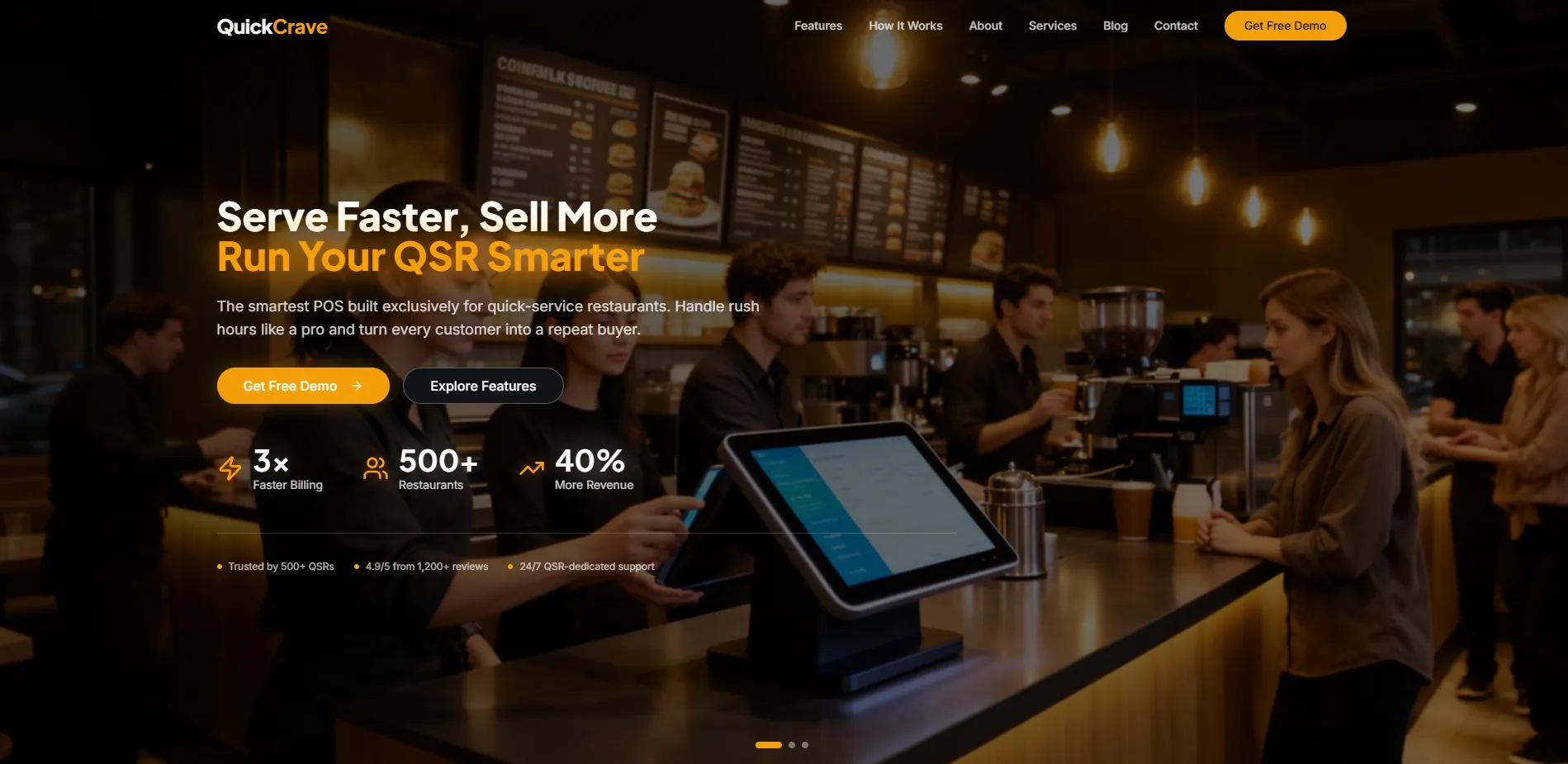
01 Challenge
Challenge
In quick service restaurants, every second directly impacts revenue. A transaction that takes 45 seconds instead of 25 may not seem significant on its own, but when multiplied across 400 customers on a busy Saturday, it results in nearly two hours of lost throughput. Over time, this inefficiency translates into substantial revenue loss and longer queues that affect customer satisfaction.
Our client, a growing QSR chain, was operating on outdated POS terminals that struggled under peak load. The systems were slow to respond, frequently crashed during busy hours, and were not compatible with modern features such as digital menu boards and self service kiosks that the business planned to introduce for scaling operations.
Operational fragmentation was a major issue. Drive through and in store orders were processed through separate systems that did not communicate with each other. This lack of integration led to inventory mismatches, inaccurate stock levels, and gaps in reporting that made it difficult for management to understand real time performance.
In addition, the business had no loyalty program in place, limiting its ability to retain repeat customers or track customer behavior over time. The owner also lacked real time visibility into sales, peak performance hours, or outlet level analytics, which made decision making reactive rather than data driven.
As the business expanded, these limitations created increasing operational strain and prevented the chain from delivering a consistent, efficient, and scalable customer experience.
02 Approach & delivery
Approach & delivery
We built a high speed QSR POS and Operations System using React.js and Node.js, specifically designed to handle the extreme throughput demands of quick service restaurant environments. The system is optimized for speed, reliability, and real time coordination across all customer touchpoints.
At the core of the solution is a multi lane counter POS system that supports simultaneous transaction handling across multiple counters. It features instant item lookup, intelligent combo auto building, and streamlined payment processing, all optimized to keep transaction times consistently under 30 seconds during peak hours.
We also implemented full drive through integration, allowing drive through orders to be processed within the same unified system as in store transactions. A dedicated drive through kitchen display system ensures clear order confirmation and preparation flow, reducing confusion and improving order accuracy.
To modernize customer experience, we developed self service kiosk ordering stations. Customers can browse the full menu, customize their meals, and complete payments directly at the kiosk. All orders are seamlessly integrated into the kitchen display and inventory system, ensuring real time synchronization across the entire operation.
The platform includes a centralized digital menu board management system that allows real time updates across all outlets. Menus can automatically switch based on time of day, enabling seamless transitions between breakfast, lunch, and dinner offerings without manual intervention at store level.
We also introduced a loyalty and mobile ordering system featuring a points based rewards program and app based order ahead functionality. This significantly reduces counter congestion during peak hours and improves customer retention through repeat engagement.
On the operational side, the system provides real time inventory alerts that notify staff before items run out during service. This prevents the common issue of customers ordering unavailable items and helps maintain a smooth and reliable service flow.
Finally, a multi location performance dashboard gives the business full visibility across all outlets. Key metrics such as live revenue, transaction volume, and average ticket size are updated in real time, enabling data driven decision making and operational control at scale.
Ready to discuss your initiative?
We scope, build, and ship tell us what you're working on and we'll share relevant references.