All case studies
RETAIL
How Alpha AutoMotive POS Helped a Multi-Branch Workshop Chain Unify Servicing, Spare Parts, and Car Wash Operations in One System
Alpha AutoMotive
A growing automotive workshop chain was running car servicing, spare parts sales, and car wash operations across multiple branches all on disconnected systems and paperwork. Alpha AutoMotive POS unified everything, and the results showed up immediately on the bottom line.
React.jsNode.jsExpress.jsMongoDBSocket.IOTailwind CSS
View live product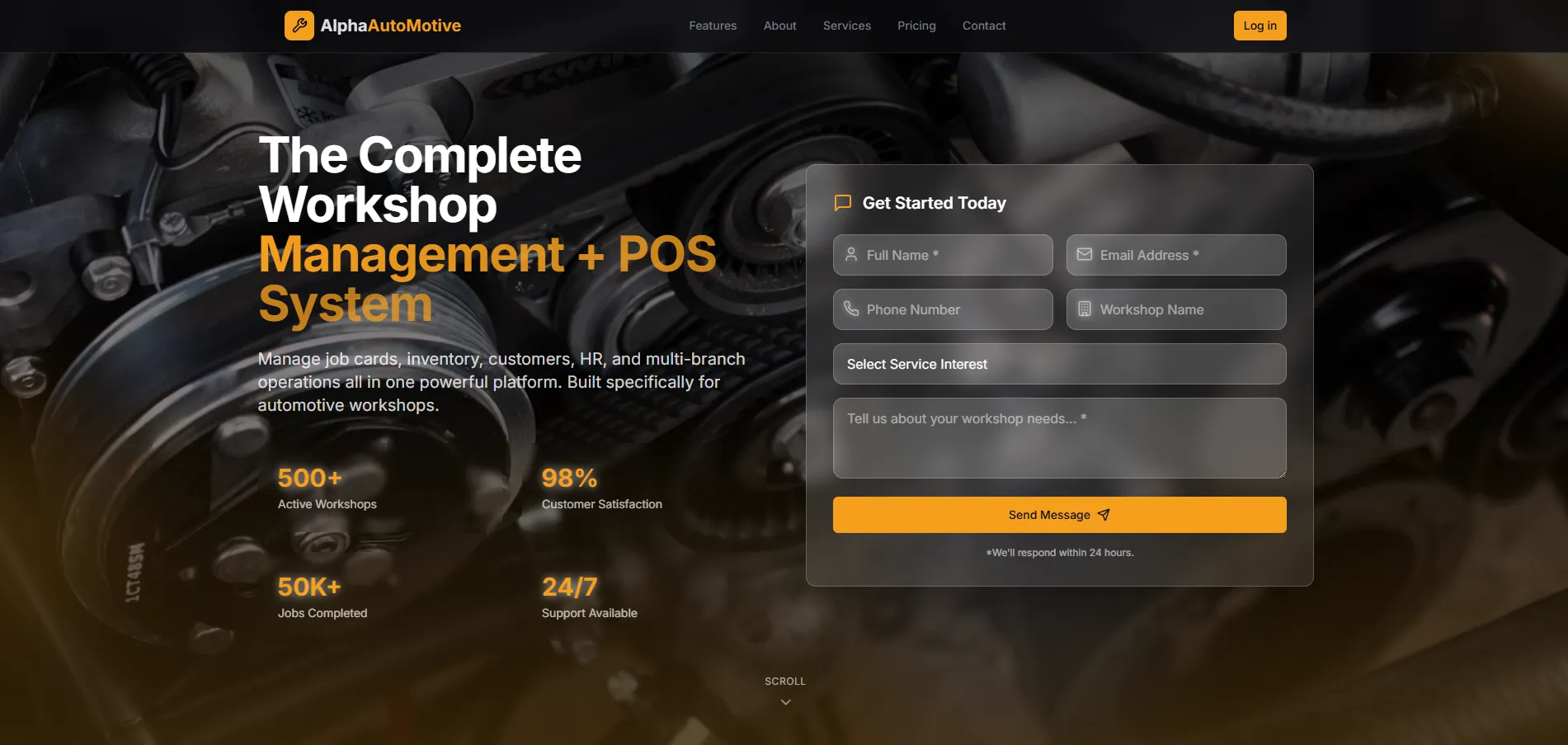
01 Challenge
Challenge
Running one automotive workshop is complex enough. Running several each handling car servicing, spare parts retail, and car wash and detailing simultaneously without a unified system is a logistical headache that gets more expensive every month.
Our client operated a multi-branch automotive workshop chain where every service type ran on its own process. Job cards for vehicle servicing were handwritten. Spare parts inventory was tracked in spreadsheets that were always a few sales behind. Car wash bookings were managed verbally or on paper. And across branches, there was no shared visibility if a part was in stock at one location but out at another, staff had no way to know without making a phone call.
Billing was the most painful part. A single customer visit could involve a service job, three spare parts, and a detailing package and producing one accurate invoice for all of it required pulling information from three different places and hoping nothing was missed.
Customer history didn't exist in any meaningful way. There was no record of what vehicle had been serviced, when, with what parts, or by which technician. Repeat customers had to explain their vehicle's history every single visit.
They needed an automotive POS and workshop management system that understood how a multi-service, multi-branch workshop actually operates and brought all of it under one roof.
02 Approach & delivery
Approach & delivery
Automotive workshops operate on workflows that generic POS systems were never designed to handle. Job cards, technician assignments, parts consumption per repair, service bay coordination, and long term vehicle history are not simple point of sale transactions. They are structured service operations that require visibility, sequencing, and accountability across multiple teams. We designed Alpha AutoMotive POS from the ground up specifically around how real workshops function in day to day operations.
Before writing a single line of code, we spent time across multiple workshop branches observing the full customer journey. From vehicle drop off, diagnosis, job creation, parts usage, repair execution, and final invoicing, we documented every step. This allowed us to identify operational friction points that were slowing down service delivery, creating communication gaps, and causing billing inconsistencies. Each of these pain points directly shaped the system requirements.
We built Alpha AutoMotive POS using React.js and Node.js, with MongoDB managing structured vehicle records, parts inventory, and job histories. Socket.IO was used to ensure all branches stay synchronized in real time, allowing updates to flow instantly between front desk, technicians, and management dashboards.
At the core of the system is digital job card management, where every vehicle service begins with a structured digital record. Customer details, vehicle information, reported issues, assigned technician, and estimated completion times are all captured in a single unified job card that follows the vehicle through its entire service lifecycle.
We implemented technician assignment and bay tracking, allowing jobs to be assigned to specific technicians with live status updates such as pending, in progress, awaiting parts, or completed. This gives front desk staff complete visibility into workshop activity without needing to physically check with technicians.
The system includes a full spare parts inventory module, with barcode scanning support, branch level stock tracking, and automatic deduction when parts are consumed during a job. This ensures inventory accuracy and prevents discrepancies between physical stock and system records.
We also built a dedicated car wash and detailing module, enabling booking management, package selection, slot scheduling, and progress tracking from check in to completion. This extends the system beyond mechanical work into full service lifecycle management.
A major improvement came from unified invoicing, where a single invoice is automatically generated per customer visit. It consolidates workshop labor, parts used, and additional services like car wash into one structured bill, eliminating manual billing errors and improving transparency.
The system maintains complete vehicle history records, storing every service, repair, and part replacement against the vehicle registration. Staff can retrieve full service history within seconds, improving diagnosis accuracy and customer trust.
We also implemented customer profiles and CRM functionality, capturing ownership details, visit frequency, spending behavior, and automated reminders for upcoming maintenance intervals. This helps workshops move from reactive service to proactive customer engagement.
For multi location operations, a live dashboard provides centralized visibility across all branches. Owners can monitor active jobs, parts availability, revenue breakdowns, and technician productivity in real time, without relying on end of day summaries.
The system also supports inter branch stock transfers, allowing parts to be moved between branches without phone calls or manual coordination. Requests are initiated directly within the POS and tracked until fulfillment.
Finally, end of day reporting provides structured insights into revenue by service type, branch performance, and technician efficiency, giving management a clear operational overview.
The rollout was executed branch by branch with on site training at each location. Despite the complexity of workshop operations, the entire system went live across all branches within three weeks, replacing fragmented manual processes with a unified operational platform.
Ready to discuss your initiative?
We scope, build, and ship tell us what you're working on and we'll share relevant references.